A mentor of mine recently asked me a question I haven't been able to stop thinking about. We were talking about side projects and ambition, and he paused and said: "What's different between being eight years old and thirty years old? At eight, there are no impossibilities. You tell people you can do something and it might not even be physically possible. But a good parent will say, well, let's try it and see what happens."
Then he looked at me and asked: "Why do you think a little bit bigger than some others? Is that transferable?"
I didn't have a prepared answer. What came out was: "I think it's curiosity."
The fort in the woods
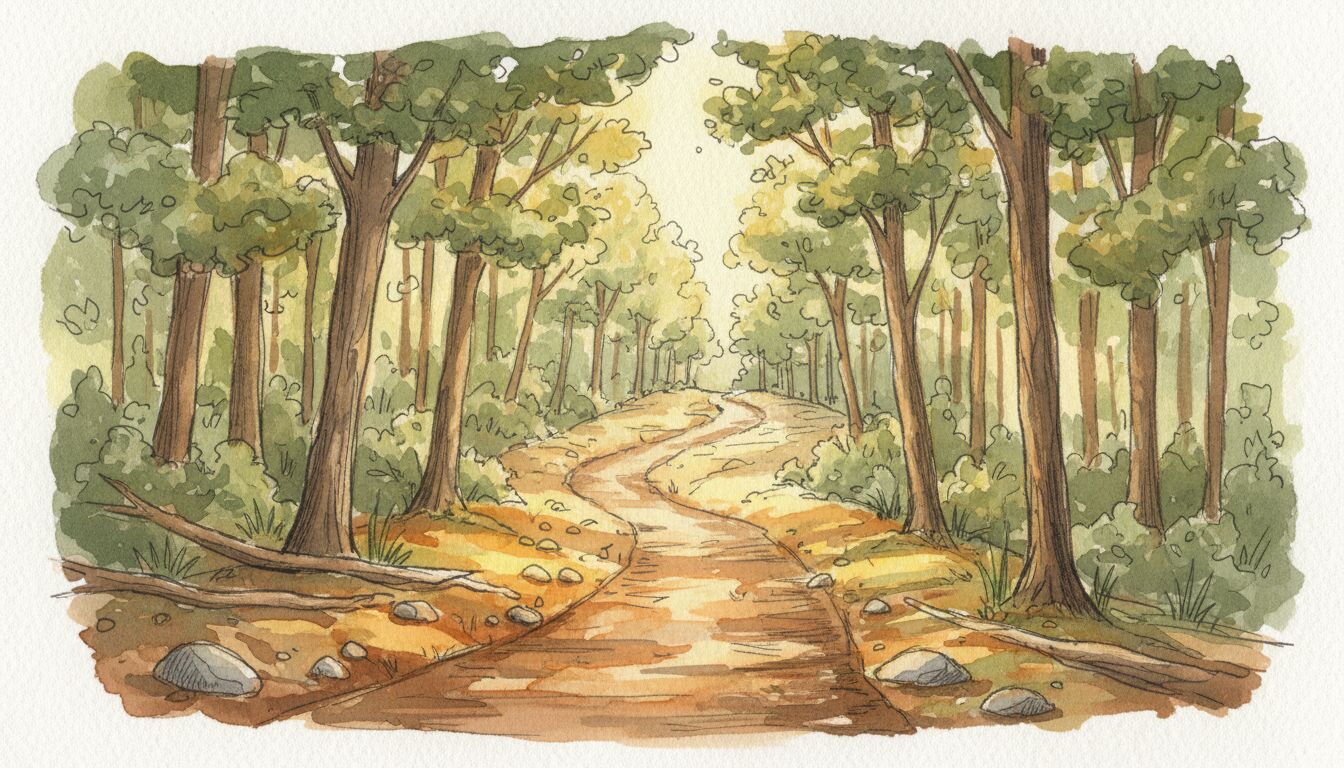
He told me a story that made the idea click. When he was a kid, he and his brothers would go into the woods and build forts. Not for an afternoon. For weeks. They'd carry junk up a mountain every day, scavenging materials, solving problems as they came up. They cut bamboo and figured out how to channel rainwater. They built a fire pit. They made a place warm enough to stay in, safe enough to sleep in. Nobody told them how to do any of it.
What struck me about the story wasn't the fort itself. It was what he said about failure: "A failure just was a next action to solve the failure." No drama, no existential crisis, no committee meeting to discuss what went wrong. Something didn't work, so you tried something else. That was the whole process.
Kids operate like this naturally. They're not worried about looking foolish or wasting time on something that might not work. They're just curious about what happens if they try. And that curiosity, combined with the willingness to spend two weeks hauling stuff up a mountain, produces something real.
Somewhere between eight and thirty, most of us lose that. Not the capability, but the willingness.
Curiosity needs friends
When my mentor pushed me on the curiosity answer, I caught myself adding qualifiers. "The fuel at least is curiosity. But that needs to work in conjunction with discipline. And then, well, there's knowledge."
It was one of those moments where you hear yourself say something and realize you actually believe it. Curiosity on its own is a spark, but sparks don't build forts. They need fuel and structure.
Think about those kids in the woods. Curiosity is what got them out there. The "I wonder what happens if..." that makes you open something up, poke at it, try an approach nobody asked you to try. But curiosity alone would have produced one afternoon of exploring and then moving on to the next shiny thing.
What kept them hauling materials up a mountain for two weeks was discipline. Not the kind imposed by a teacher or a deadline, but the kind that comes from caring enough to show up again tomorrow. The fort didn't materialize from a single burst of inspiration. It accumulated, one trip up the mountain at a time. Without discipline, curiosity produces a collection of half-started projects and nothing that actually works.
And what turned all that effort into a functioning shelter was knowledge, built problem by problem. Each failed attempt to channel rainwater taught them something about how water moves. Each collapsed wall taught them about structural support. The more they knew, the more interesting their questions became, and the more their curiosity had to work with. That's how broad experience compounds: you start recognizing patterns across domains, applying solutions from one context to another. Knowledge gives curiosity direction. Without it, you're just exploring randomly.
The three feed each other. Curiosity drives you to learn new things. Knowledge makes your curiosity more targeted. Discipline keeps you engaged long enough for the compound effects to kick in. Remove any one, and the system stalls.
What kills the spark
If curiosity is so natural (every child has it in abundance), why does it fade? I don't think it actually dies. I think it gets buried under layers of professional and social pressure.
The corporate world, in particular, has a way of rewarding the appearance of knowledge over the pursuit of it. Admitting you don't know something can feel risky. Asking "what if we tried something completely different?" can feel naive. Spending time exploring a tangent that might not lead anywhere can feel irresponsible when there are deadlines and roadmaps and quarterly objectives.
Here's what I think is happening: curiosity maps almost directly onto mastery, the desire to get better at something that matters. But mastery requires space to experiment, to fail, to follow threads that don't obviously lead anywhere. When organizations squeeze out that space through over-scheduling, rigid processes, or cultures that punish exploration, they're not just limiting innovation. They're suffocating the curiosity that drives it.
The fort builders didn't have a product roadmap. They had curiosity, time, and permission to fail. Most breakthroughs work this way. They don't come from grand plans. They come from environments where people are free to experiment, where ideas can collide and recombine through trial and error. That's what the woods provided, and it's what the best engineering teams provide too.
Is it transferable?
My mentor's original question was whether thinking bigger is something you can teach or pass on. I've been turning that over ever since.
I don't think you can teach curiosity directly. You can't mandate it or incentivize it into existence with a bonus structure. But I do think you can create conditions where it survives.
In my own life, I can trace this orientation back to growing up in Colombia in the 90s, where resources were scarce and "just buy a new one" wasn't usually an option. So you learned to take things apart. You experimented. You failed and tried again. The specific content didn't matter. What mattered was the habit of treating "I don't know how" as a starting point rather than a reason to stop. That environment didn't teach me curiosity. It gave curiosity room to operate by making it useful.
I see the same thing in myself now. Not long ago, I spent several evenings building a prototype that combined search APIs with AI models, purely because I wanted to know if a particular approach would work. No ticket, no deadline, no clear next step. Just curiosity about whether the pieces could fit together. The discipline was showing up evening after evening when I could have been doing anything else. The knowledge was years of working with search infrastructure that told me where to look. That's the trio in action.
I've seen the same dynamic in engineering teams. The teams where people explore technologies outside their immediate scope and share what they're learning aren't necessarily teams with more curious people. They're teams where curiosity is treated as an asset rather than a distraction. Where "I spent Friday afternoon experimenting with something" is met with "what did you find?" rather than "was that in the sprint?"
The fort in the woods worked because no adult showed up to ask for a project plan. The kids just had space, materials, and problems worth solving.
Carrying things up the mountain
What I keep coming back to is the image of kids carrying junk up a mountain for two weeks. Not because someone told them to. Not because there was a reward at the end. But because they were curious about what they could build, disciplined enough to show up every day, and building knowledge with each problem they solved along the way.
That's the trio. Curiosity gets you into the woods. Discipline keeps you hauling materials up the mountain. Knowledge helps you turn those materials into something that actually works.
I think about this when I catch myself getting comfortable. When I notice I haven't explored something unfamiliar in a while, or when the projects I'm working on feel purely routine. It's a signal that one of the three might need attention. Maybe curiosity needs a new problem to chew on. Maybe discipline has slipped and I'm dabbling instead of committing. Maybe I need to invest in learning something that gives my curiosity better direction.
The question my mentor asked, whether this is transferable, I still don't fully know. But I suspect the answer has less to do with teaching people to be curious and more to do with not squashing the curiosity they already have. Give people space to wonder. Let failure be the next action, not the last one. And carry things up the mountain, even when you're not sure what you're building yet.
Most eight-year-olds already know how to do this. The challenge isn't learning it. It's remembering.