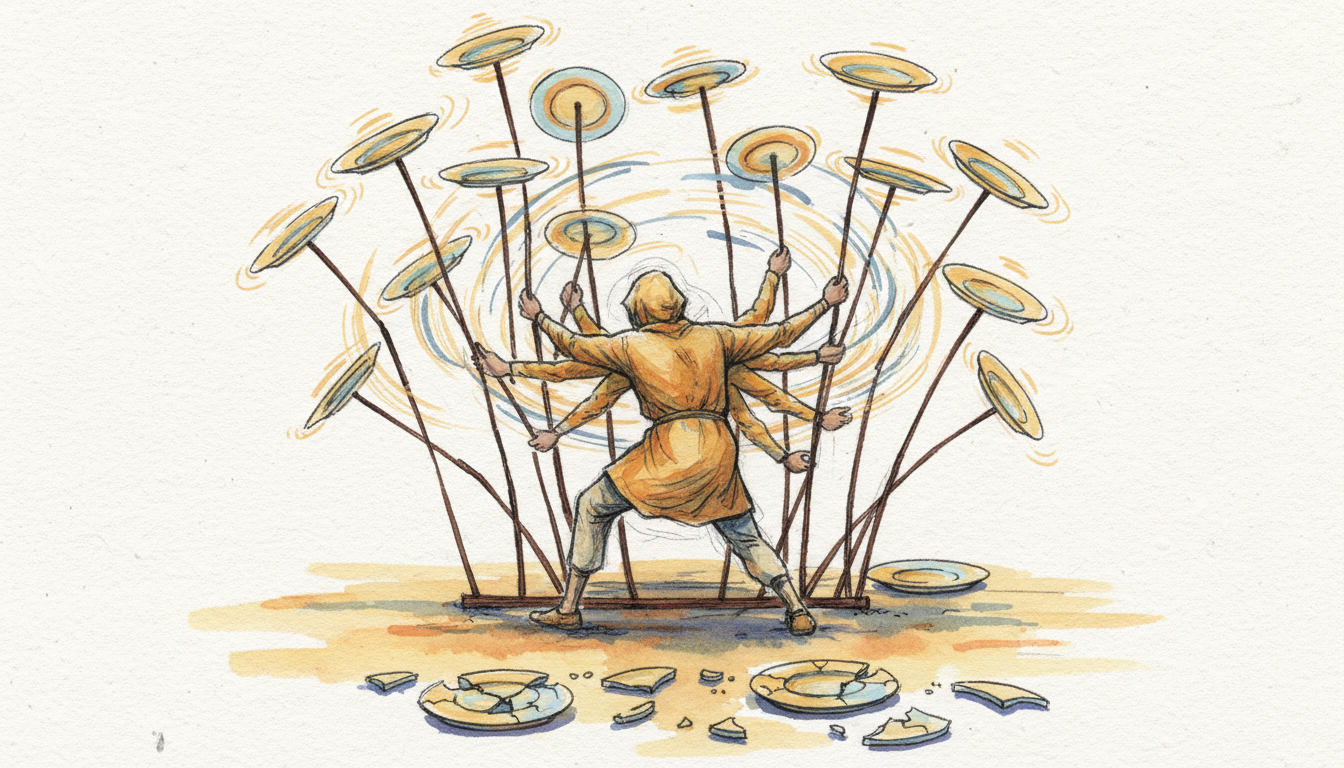
I noticed it creeping in over a few weeks during the initial stages of the recent AI boom. The day would wind down, and instead of closing the laptop, I'd check my AI usage. Credits remaining. And then, almost automatically, I'd open another session. Not because I had something urgent to work on, but because the credits were there. Like a slot machine that resets every morning, except the currency is your own attention and the jackpot is... more work.
I subscribe to an AI coding assistant. It's genuinely impressive, and the work I've done with it (researching ideas, writing code, exploring concepts, prototyping) has been some of the most productive of my career. But the subscription comes with daily credits that reset every 24 hours. Use them or lose them. That small design detail, I've realized, quietly rewired something in how I relate to my own time.
The compulsion loop
Here's what the pattern looked like in practice. I'd be working on something, hit a point where I needed to think, and instead of sitting with the problem, I'd offload it to an agent. "Figure out the best approach for X." The agent would churn away, and my brain would immediately register: freed up. Not "resting." Not "processing in the background." Just available for the next thing.
Previously, hitting a block meant going to the gym, taking a walk, or just staring at the ceiling for a while. The answer would surface eventually, often in the shower the next morning or during a conversation about something completely unrelated. That background processing was slow and unpredictable, but it was also deeply human. It was my thinking, happening on my schedule, producing insights that felt earned.
Now that background process is an agent. It finishes in minutes, not hours. And instead of using the freed-up mental space to rest, I'd fill it. "What else can I be doing? I still have credits. Let me research this other thing. Let me start that project I've been putting off. Let me run another experiment." The shower moment didn't disappear. I just stopped waiting for it. I outsourced it, and then immediately put myself back to work.
Every task I offloaded became a spinning plate. And every plate I set spinning freed up my hands to start another one. Research this topic. Draft that post. Prototype this idea. Explore that architecture. Each one running in a different session, each one needing me to check back, review the output, and decide what to do next. Before I knew it, I had a dozen plates in the air, and the compulsion wasn't just to start them. It was to keep checking on them, keep feeding them, keep adding more. The tool doesn't sleep, doesn't take breaks, doesn't tell you to go home. Unlike a colleague who eventually says "let's pick this up tomorrow," the AI is endlessly patient, endlessly available, endlessly ready. And the credits reset daily, turning a useful tool into a compulsion to keep every plate spinning.
When everywhere is the office
The problem got worse because of where I work: at home.
When I started working remotely, the appeal was obvious. No commute, flexible hours, comfortable environment. But over time, the physical space that was supposed to be mine became everything. My desk was my workspace, my gaming setup, my personal project station, and now, my AI lab. The boundaries that once existed between "work mode" and "home mode" dissolved into a single space where the next task was always one open tab away.
I found myself frantically trying to finish everything at the same time. My mind was racing constantly. I wasn't really present with my wife, or with friends, or even with myself. I'd be having dinner and thinking about something I could be running an agent on. I'd be on the couch and realize I was mentally composing prompts instead of watching the movie. I kept thinking about work, about things I could be researching, building, optimizing. The credits were resetting tomorrow, and I hadn't used today's allocation.
This wasn't burnout in the traditional sense. I wasn't exhausted from overwork. I was exhausted from the inability to stop. The bottleneck had shifted in a way I didn't expect. It used to be "I can't do enough." Now it was "I can't stop doing."
Work expands to fill the tool
There's an old observation called Parkinson's Law: work expands to fill the time available for its completion. I think we're watching a new version of this play out. Work expands to fill the capability available for its completion.
The more capable the tool, the more you feel you should be producing. When all I had was a text editor and a terminal, there was a natural limit to how much I could accomplish in an evening. Now, with an AI that can research, code, write, and analyze in parallel, the ceiling has moved. And my internal expectations have moved with it.
But here's what hasn't moved: my brain. My cognitive capacity is the same as it was before these tools existed. I still need sleep, still need downtime, still need unstructured time where nothing productive is happening. The tool scaled. I didn't. And the gap between what the tool can do and what I can sustain is where the compulsion lives.
Something has to give
I've been thinking about the lessons from Cal Newport's Slow Productivity lately, and a line keeps coming back to me: the idea that real accomplishment requires working at a natural pace, not a manufactured one. Long stretches of apparent idleness between bursts of output. The opposite of how I'd been operating.
I don't have a clean resolution for this. I'm still in it. Some days I catch myself checking the usage dashboard at 5 PM and close the laptop. Other days I don't catch myself at all, and I'm up until midnight in three different rabbit holes because the credits are right there and I am sooooo close!
And every now and then that is ok, and I actually encourage it. But the rabbit holes had become the norm. Deep dives and hyper-drive on some things is not inherently bad, unless that becomes the default behavior, hurting some other aspects of your life.
As I rebalanced my energy and put a lid on this newfound compulsion, I found myself slipping smoothly into my regular self. I spend time with my wife. I cook dinner without thinking about prompts. Pick up my guitar. I read a physical book. I go for a walk with no particular destination and no podcast filling the silence. And sometimes, during those analog hours, the idea I'd been trying to force out of an agent just arrives. Uninvited, unscheduled, fully formed. The shower moment, doing what it always did, when I finally gave it room.